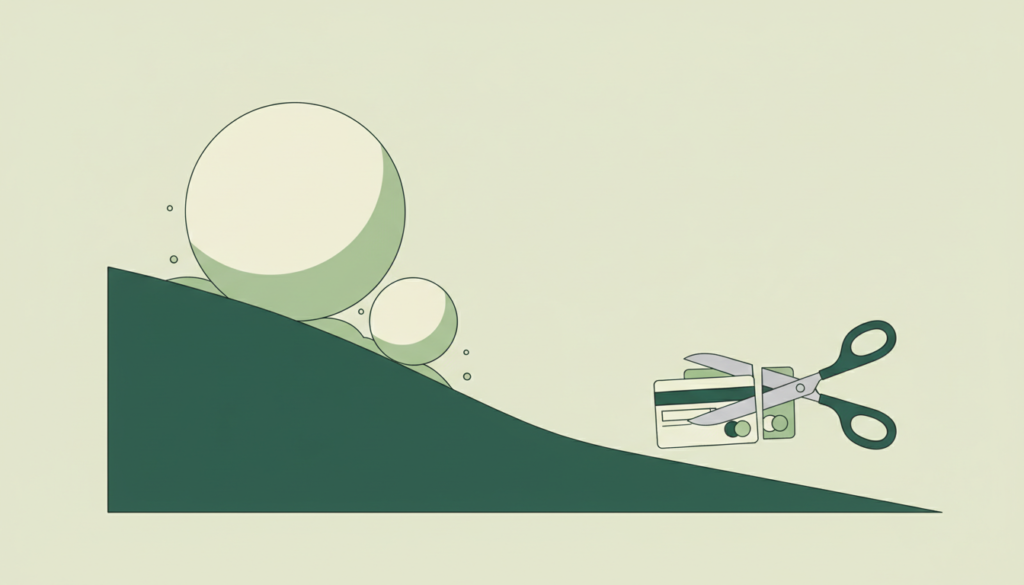
If you have several debts, such as two credit cards, a personal loan and a car loan, the hardest question is often where to start. Two popular methods give a clear answer: the debt snowball and the debt avalanche. Both work. One saves more money; the other often keeps people motivated for longer. Here’s how each works, with a worked example.
The rules both methods share
- Pay the minimum payment on every debt, every month, so you avoid late fees and damage to your credit record.
- Put every extra pound, dollar or euro you can find toward one target debt.
- When that debt is paid off, roll its payment into the next target. The amount you’re throwing at debt grows each time, which is why it’s called a snowball.
The only difference between the methods is the order of the targets.
Snowball: smallest balance first
List your debts from the smallest balance to the largest, ignoring interest rates. Attack the smallest first. You get a quick win, often within a few months, and each closed account is a visible sign of progress. Research on consumer behaviour, including studies published in the Journal of Consumer Research and Harvard Business Review, suggests that these early wins help people stick with repayment.
Avalanche: highest interest rate first
List your debts from the highest interest rate to the lowest. Attack the most expensive first. Mathematically this is the cheapest way to pay off debt, because you’re always reducing the balance that grows fastest.
A worked example
Imagine these three debts, and 600 a month available for debt in total:
| Debt | Balance | Interest (APR) | Minimum |
|---|---|---|---|
| Store card | 800 | 29% | 25 |
| Credit card | 4,000 | 22% | 100 |
| Car loan | 6,000 | 8% | 180 |
Minimums total 305, leaving 295 extra each month.
- Snowball order: store card (800) → credit card (4,000) → car loan (6,000).
- Avalanche order: store card (29%) → credit card (22%) → car loan (8%).
Here the two orders happen to be the same, so the choice doesn’t matter. That’s common: small store cards often carry the highest rates. The methods only diverge when a small debt has a low rate, for example a 1,000 interest-free loan from a family member alongside a 3,000 card at 24%. Snowball would pay the family loan first; avalanche would pay the card first, saving more in interest.
Side by side
| Snowball | Avalanche | |
|---|---|---|
| Target first | Smallest balance | Highest interest rate |
| Total interest paid | Same or higher | Lowest |
| First debt cleared | Usually sooner | Can take longer |
| Best for | People who need motivation | People driven by numbers |
Which should you choose?
If your highest-rate debt is also large and the rate gap is big, the avalanche can save a meaningful amount. If you’ve tried and given up before, the snowball’s quick wins may be worth the small extra cost. A hybrid also works: clear one tiny debt for a fast win, then switch to the avalanche. The best method is the one you’ll keep doing.
Make either method work faster
- Stop adding new debt. Remove saved cards from shopping sites while you pay down.
- Keep a small emergency buffer so a surprise bill doesn’t go back on a card.
- Ask for a lower rate. A polite call to your card provider sometimes works, especially with a good payment record.
- Consider a 0% balance transfer if you qualify, but check the transfer fee and the rate after the offer ends.
To find the extra money each month, start with a simple budget such as the 50/30/20 rule, and build a starter emergency fund alongside.
General information only, not financial advice. If debt feels unmanageable, free, impartial debt advice services are available in many countries.
About the writer: Ahmed.B
Ahmed writes Tidibook’s personal finance guides: budgeting, saving and paying off debt, explained with simple worked examples.
1 comment