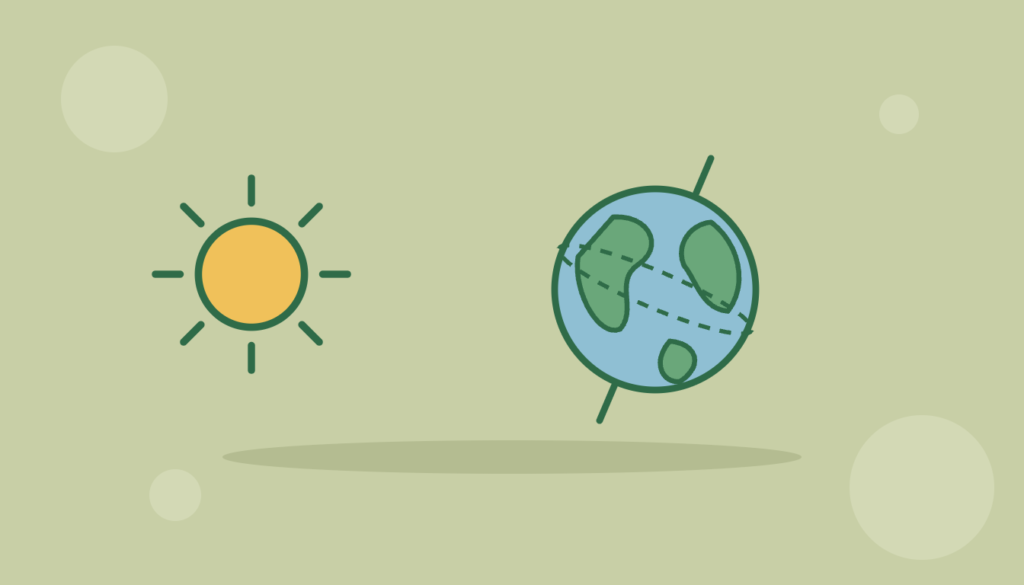
Ask people why summer is warm and many will say “because Earth is closer to the Sun”. It’s a natural guess, but it’s wrong. Earth is actually closest to the Sun in early January, during the Northern Hemisphere’s winter. The real reason for the seasons is a tilt.
Earth is tilted
Earth spins around an imaginary line, its axis, running through the North and South Poles. That axis isn’t upright compared with Earth’s path around the Sun; it’s tilted by about 23.4 degrees. Crucially, the tilt always points in the same direction in space (roughly toward Polaris, the North Star) as Earth travels around its yearly orbit.
So for part of the year, the Northern Hemisphere leans toward the Sun, and six months later it leans away. The Southern Hemisphere experiences the opposite, which is why it’s summer in Australia when it’s winter in Europe.
Why leaning toward the Sun makes it warmer
Two effects work together:
- The Sun is higher in the sky. Sunlight hits the ground more directly, concentrating its energy on a smaller area. Shine a torch straight down at a table, then at an angle: the angled beam spreads into a larger, dimmer patch. Low winter sunlight is like that angled beam.
- Days are longer. More hours of daylight mean more time to heat the land and sea, and fewer hours of night to cool down.
The key dates
| Approximate date | Event | Northern Hemisphere | Southern Hemisphere |
|---|---|---|---|
| 20–21 March | Equinox | Spring begins | Autumn begins |
| 20–21 June | Solstice | Longest day, summer | Shortest day, winter |
| 22–23 September | Equinox | Autumn begins | Spring begins |
| 21–22 December | Solstice | Shortest day, winter | Longest day, summer |
At the equinoxes, neither hemisphere leans toward the Sun, and day and night are roughly equal everywhere. At the solstices, the tilt toward or away from the Sun is at its greatest.
What about distance?
Earth’s orbit is only slightly oval. At its closest, in early January, Earth is about 147 million km from the Sun; at its farthest, in early July, about 152 million km. That difference of around 3% changes the sunlight reaching Earth by roughly 7%, which is far smaller than the effect of the tilt. If distance were the main cause, both hemispheres would have summer at the same time, and they don’t.
Why the hottest days come after the solstice
The longest day is in June (in the north), yet July and August are often hotter. This “seasonal lag” happens because land and especially oceans take weeks to warm up, like a pan of water that keeps getting hotter after you turn the heat up. The same delay makes late January and February the coldest months.
Seasons around the world
- Near the equator, the Sun is high all year, so temperatures barely change. Seasons there are often defined by rainfall: wet and dry.
- Near the poles, the tilt causes extremes: months of midnight sun in summer and months of darkness in winter.
What if Earth had no tilt?
With no tilt, there would be no seasons: every day would be like an equinox, with the same weather pattern year-round at any given place. Planets show how much tilt matters: Uranus is tipped over by about 98 degrees, giving it extreme seasons that each last around 21 Earth years.
Sunlight’s journey through the atmosphere explains another everyday sight; see why the sky is blue.
About the writer: Karim.A
Karim writes Tidibook’s science explainers: how the natural world works, in short and simple language.